

Send Nudes, I
substack please don't censor me thanks x

Two summers running, I found myself on a bus trapped behind London’s annual naked bike ride. On neither occasion was I remotely offended, but I spotted some who were, mostly tourists and families. I was reminded, strangely, of a memory of childhood in which I was caught by my mother browsing a book in the British Museum shop about sexuality in ancient art. It was inappropriate, she told me, and I should know I was too young for it, at eight or so. I was too embarrassed to argue, but I felt misunderstood, unfairly chastised – it wasn’t about sex as I understood it (from playground whispers and TV, I suppose), it was about nudity and gender and the body, nothing obscene at all. It was no more offensive than the anatomy encyclopedia we had at home or the changing rooms on school trips to the local swimming pool.1
There are circumstances where so-called indecent exposure is a sexually threatening behaviour, but nudity is contextual: two dozen naked, middle-aged hippies on bikes are far from it. The World Naked Bike Ride is a strange product of the early 2000s, beginning as environmental protests in Spain and Canada, surely influenced by and connected to the huge anti-war movement of the period. Now, the ride has a variety of aims and messages, largely against pollution and car culture and for community and body positivity. It doesn’t seem a hugely effective protest tactic, but it’s a memorable one, something I return to when thinking about nudity.
In the titular story of Saba Sams’ Send Nudes, a woman flirts online with a stranger from a chat room as a storm approaches. It’s a seedy conversation, a little bit retro. The stranger asks asl? and the woman has to ask what it means. He asks her to send nudes. She ruminates, imagining his polite, firm response: sorry but I’m not rly into big girls. She cries in the shower and eats a sad snack from her bare cupboards, but finds herself walking around her home naked for the first time, buoyed by this stranger’s interest. In the thick of the storm, she takes and sends the photo, disconnecting from the conversation before he can respond. In the morning, the world is not over, and she feels comfortable venturing out without shapewear and eating a pastry without caring about the mess or indulgence.
The story is a little neater than I’d like, a little too contained — one small encounter over one day. I think grappling with how to feel about your body, about nudity and sex and fatness and gender, is a fraught and knotty process, one that’s maybe never quite finished. That’s a more interesting story to me, if a harder one to tell. This is maybe a little unfair on Sams; I loved the collection and liked this story, and have only thought critically about it at all upon revisiting it to write this.
As an aside: I think this is not an indictment of her work (which again — I love!) so much as it’s a question I am puzzling out on the form of the short story. When I try to write short stories lately, I think of seeing Tessa Hadley talk a few years ago, saying that the marvellous thing about the form is that you can cover twenty years in a paragraph change, just saying: ‘twenty years later…’ and moving along. There is a tendency, especially in more formalised writing education, to recommend that short fiction should not be too ambitious in scope. I was once a nineteen-year-old trying to squeeze a novel's worth of plot into a thousand words, so I’m sympathetic to this view. Still, I think it is a shame that redirecting towards concision and simplicity should be so frequently limited to short plots and to stories of a few scenes, which could so often pass as excerpts of novels.
When Hadley’s stories are ‘contained episodes’, they leave more questions open than resolved (think — ‘Dido’s Lament’). But I think she particularly excels at stories that stretch along through time without an overreach of plot (‘After the Funeral’). Even her novels play with time and scope like this, hopping into the past (The Past; Late in the Day) and even looping back to the present to land a perfect ending (The London Train).
The short story is a more robust and versatile form than often given credit for, even if we’re only looking at realist literary fiction — it’s why every Lydia Davis story seems to expand what I thought was possible.2 Of course, there is probably a material element to the ways recent short fiction falls short for me. These collections are often debuts by writers who go on to be novelists, and who have published short stories in lit mags and entered them into contests as they tried to get off the ground, eventually landing a two-book deal to publish a collection and follow it up with a novel. In the print age, short stories were read by all kinds of readers in all kinds of genres, and writers like Hemingway and Fitzgerald were paid hundreds of dollars — thousands in today’s money — for single stories. Now, especially for young writers, many seem (at least to me) to be approached more as an opportunity to audition for the role of novelist than anything else. (Once again, the root of my dissatisfaction is the whims of the market…)
None of this is hugely relevant to what this piece is supposed to be about, except that it is worth considering the external factors shaping the stories — in art, in news, in casual conversation — we tell and encounter. I don’t know that the sentimentality I often find in overly didactic work about the body particularly speaks to the experience of being a real, messy, shame-ridden, egotistical woman in the world. It’s easy to lean on the same old beats — sex with the lights off, blankets over the mirrors, a refusal to be naked aligning with a hatred of one’s body — but even when they do ring true, they flatten all the tension and conflict of the experience. The line of questioning is foreclosed by these neat conclusions, where it ought to be opened further.
nudity in the wild
One of the things about adulthood that has surprised me the most is how much I enjoy being naked. The self-consciousness and squeamishness of my adolescence — in myself, in other girls, in adults, almost embarrassed by the awkwardness of pubescent metamorphosis — felt so natural and inevitable that I was surprised when it waned. For maybe a decade, my body was the thing I thought about more than anything else, and then one day, it was just there, sometimes pleasant and sometimes inconvenient.
Self-hatred, or at least insecurity, was a habit of my youth I felt swept up in, a clumsy shortcut to female camaraderie rather than anything rooted in sincere belief. These insecurities became truer for voicing them, but removed from the kind of peers who frequently expressed these things, they faded quickly.
Now, nudity feels like a strange privilege. Lying topless in the meadow at the ladies’ pond. Hot summer nights sleeping naked on clean linen sheets beneath the blast of my desk fan. Finding the flat empty for a few days, lazily wandering from room to room. I often catch naked neighbours in nearby blocks of flats; they, too, have presumed that a few floors up and away from the road, no one will notice. If it stops me in a moment of recognition and respect, I laugh and leave them to it. (I’ve actually never been skinny dipping, much to everyone’s surprise.)
pornography and art
What distinguishes the artistic nude from pornography isn’t exactly a resolved question. To some, all nudity is indecent; to others, artistry can be found everywhere. In The Sadeian Woman, Angela Carter writes, “there is no question of an aesthetics of pornography. It can never be art for art’s sake”. For Carter, pornography’s role, at least in the 20th-century, is to “defuse the explosive potential of all sexuality”. It “keeps sex in its place, that is, under the carpet.” In her view, porn is provocative and titillating but also deeply ideological, selling a narrow fantasy of what sex does and should look like. It’s hard to disagree with this now: the ease of access to porn has not made sex a less fraught terrain. Still, artistic nudes, particularly those with the respectable veneer of history, are permitted where nakedness is generally not. Within a museum frame, they are safely contained.


I love nude paintings. I never entirely lose sight of their often sexist history, the grand tradition of men objectifying naked women, but much feminist criticism on this point irritates me by beginning from the view that there is something inherently degrading about being seen naked, which I do not believe.3 I feel a great tenderness for these paintings, the softness of the body, the life in every dimple and crease and curve.
My favourite is Gustave Courbet’s L’Origine du Monde, because I am not very original. The painting was commissioned by Khalil Sherif Pasha, an Ottoman diplomat and art collector, as part of a personal collection of erotic paintings. These are interesting origins: it is not a cheap postcard or print, but an artwork commissioned from a visionary, politically notorious artist. That’s not to say the motives behind such a work were entirely pure, but rather that, just as Anaïs Nin and Henry Miller insisted on retaining a literary style when commissioned to write erotica for a private collector, Courbet does not abandon his artistry. The painting passed through various hands, eventually bought by psychoanalyst Jules Lacan in 1955; he and his wife, Sylvia Bataille, displayed it privately in their country house. A wooden door – decorated by André Mason with a surrealist carving inspired by the work – hid the painting, sliding to reveal the painting to visiting guests, including Marcel Duchamp, Marguerite Duras and Pablo Picasso. It was a set-up that made a ceremony of unveiling the work. Pulling the door aside, the woman is undressed, an action more suggestive than her nudity alone.
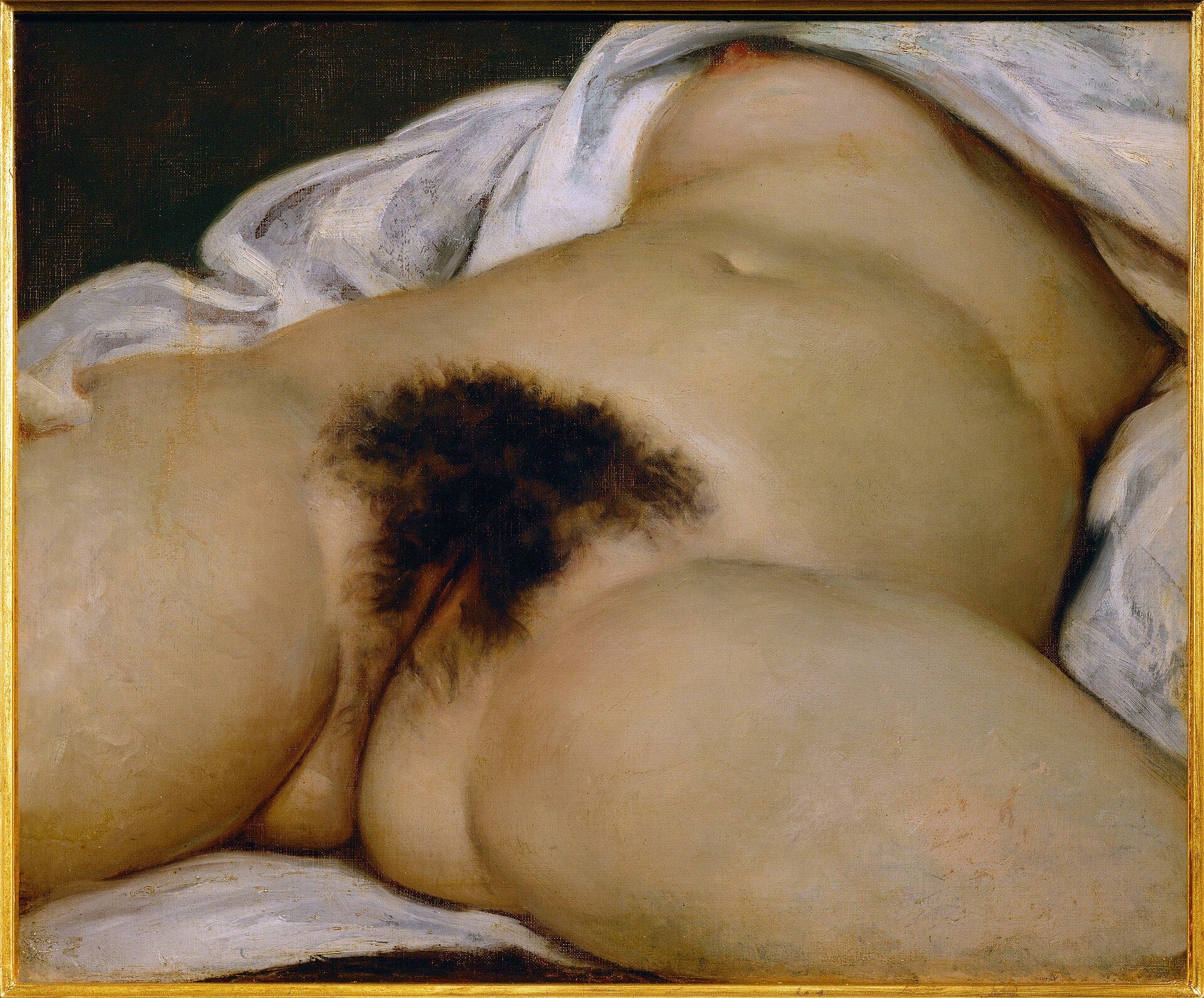
For Courbet, his socialist politics were a huge element of his interest in realism, in opposition to the saccharine, misogynistic work of French Academicism, the leading movement of the period.4 In his nudes, Courbet rejected the idealism of Academicism, painting bodies that look soft and flawed and real.
I don’t think it’s an ‘innocent’ work. Can a painting even be such a thing? There is a voyeurism to his nudes that both depicts more ‘natural’ bodies in more ‘natural’ circumstances, and eroticises this unhibited nudity in the private world. In a patriarchal world, this is fraught, but I don’t think it is politically inconsistent to be moved by the tenderness of Courbet’s erotic work despite this. On this, my best friend said that an artist working against one kind of misogyny will not necessarily avoid reproducing another.
I’m unsettled by responses that censor the painting, that approach it via innuendo and prurience and outrage. Consider Deborah de Robertis’ performance vandalising the painting, or the cover of Gavin McCrea’s Cells, which coyly crops the painting. These remind me of a Mormon I knew as a teenager, who once shared on Facebook that she’d pinned a paper T-Shirt to an Abercrombie shopping bag to cover the bare chest of the model pictured on it. She captioned the photo #ModestIsHottest.
The original painting is explicit in both senses of the word; even 150 years later, it remains a confronting image. To censor it removes its primary power, euphemistic in a way that amounts to little more than a gimmick. I can understand that the painting would have been outrageous in the context of the social conservatism of the Second French Empire, but sitting with it in the twenty-first century, I feel surprised by such objections. Is a woman’s body still so scandalous? Is anyone’s?
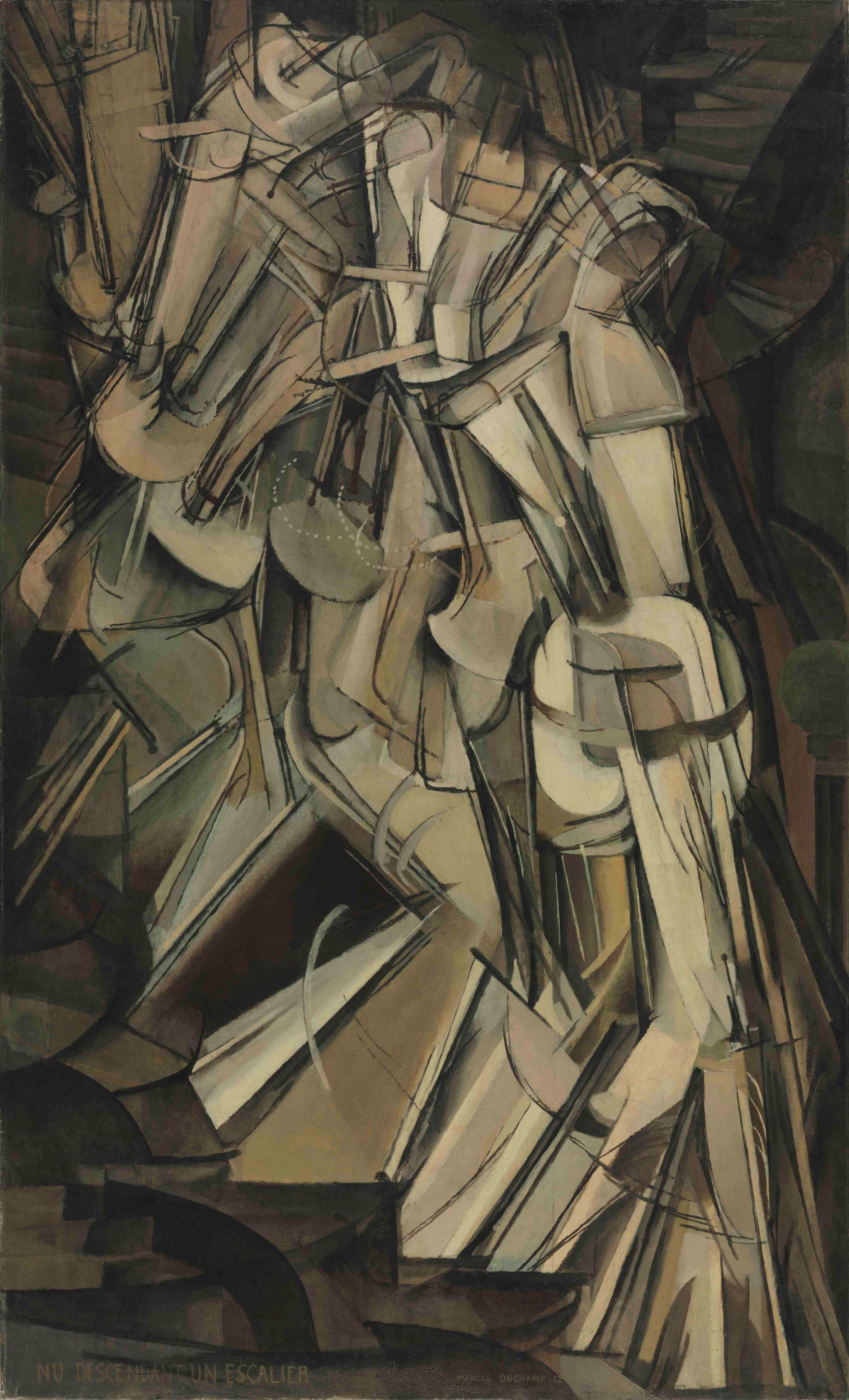
I love Duchamp’s various iterations of Nude Descending a Staircase, capturing a body in motion in a way that makes me think of a reel of film, frames of celluloid laid upon one another. It’s a painting Frank O’Hara’s most famous poem introduced to me – an ode to his lover, the dancer Vincent Warren, in which the painting is just another work made irrelevant by Warren’s beauty and O’Hara’s desire and love for him. O’Hara’s poems are obsessed with motion – cinema, dance, action painting – a preoccupation in this poem which reflects a very bodily appreciation of Warren, erotic, artistic and aesthetic. Only a line before O’Hara’s Duchamp reference, he remarks that “the fact that you move so beautifully more or less takes care of futurism”. We are a long way from the idealised, frozen forms of Academic nudes here (“as still/as solemn as unpleasantly definitive as statuary”, perhaps?).
On a larger scale, Modernism didn’t exactly represent a total overhaul of old, misogynistic traditions. But between the artistic experiments of the era and the growth of opportunities for female artists, it did mean a proliferation of new perspectives on the body. At the Tate’s Lee Miller exhibition last year, I was particularly taken by her nude photographs – images both playful and assertive, frequently self-portraits. In these photos, largely from her surrealist period working alongside Man Ray, I found some seeds of the confronting gaze found in that famous photograph of her in Hitler’s bathtub, not to mention the audacity, though these are naturally far more light-hearted.
In this vein, I love the personality a nude can contain: consider Larry Rivers’ cool and mischievous portrait of poet Frank O’Hara, aptly titled O’Hara Nude with Boots, or the pain and self-possession in Frida Kahlo’s Broken Column. One of Peter Hujar’s nude portraits features Bruce de Sainte Croix “looking at his erection with the same kind of contemplation as the viewer studying it”, in the words of photography critic Philip Gefter. Francesca Woodman frequently took nude self-portraits, staging her own body as an ironic riff on the nude in classical sculpture.


In the recent Leigh Bowery exhibition, not exactly short on explicit imagery, I was struck by Lucian Freud’s nude paintings of Bowery, which seemed far more exposing than, say, images of a Bowery performance in which he sprayed the audience with water from his arse. In one photograph documenting their work together, Freud and Bowery riff on Courbet. Like any other artwork, nudes are always in conversation with the tradition that precedes them.5
I enjoy nudes for many reasons, but I think one in particular is their complexity and ambiguity. Images dominate our era. The textual promise of the early internet has waned; I wonder now if humans have ever been so inundated with visual representations. I feel overwhelmed by how much of this is advertising: flat, soothing, seductive, plastic. As such, these images are only loyal to the bottom line, selling sex, shame, freedom, and whatever else is trending. Each of these images is a sycophantic pitch to us; they have little interest in truth.
I’m weary of clichés, of narratives about our bodies that run too smoothly. I love the friction involved in looking at these artworks, just as I enjoy the friction of embodied experience. Such friction is often deeply frustrating, but eventually very rewarding too. Is this the basis of the erotic? I’m thinking a lot lately about how magnetism involves push and pull. You recoil and then draw in. There is so much living in the space of that uncertainty.
In Part II: nudity on screen & online…
Where, coincidentally, it was never my naked body drawing the attention of others, but the ‘birthmark’ on my shoulder, later identified as cancer. lol.
I think about ‘French Lesson I’ all the time; it astonished me.
There is, of course, plenty to be said about women confined to the position of muse and sexual object while artists were (and to some extent still are) overwhelmingly men. I agree with the Guerrilla Girls’ provocation: do women have to be naked to get into the Met Museum? (An aside: isn’t it interesting that the Tate sells so much Guerrilla Girls merch in their shops, surely disproportionate to the volume of feminist art they actually exhibit?)
I recommend John Berger’s chapter on Courbet in Portraits, who he calls “ the only great painter to challenge the chosen ignorance of the cultured”.
And yet, the nudes at Freud’s recent exhibition did little for me; I was far more interested in the surreal work from his earlier career than the realism of his later work.
This is great. Also made me realise for the first time that Duchamp's last work - a nasty and voyeuristic kind of take on the nude that almost seems to anticipate true crime documentaties - is also riffing on Courbet. Had never made the connection before.